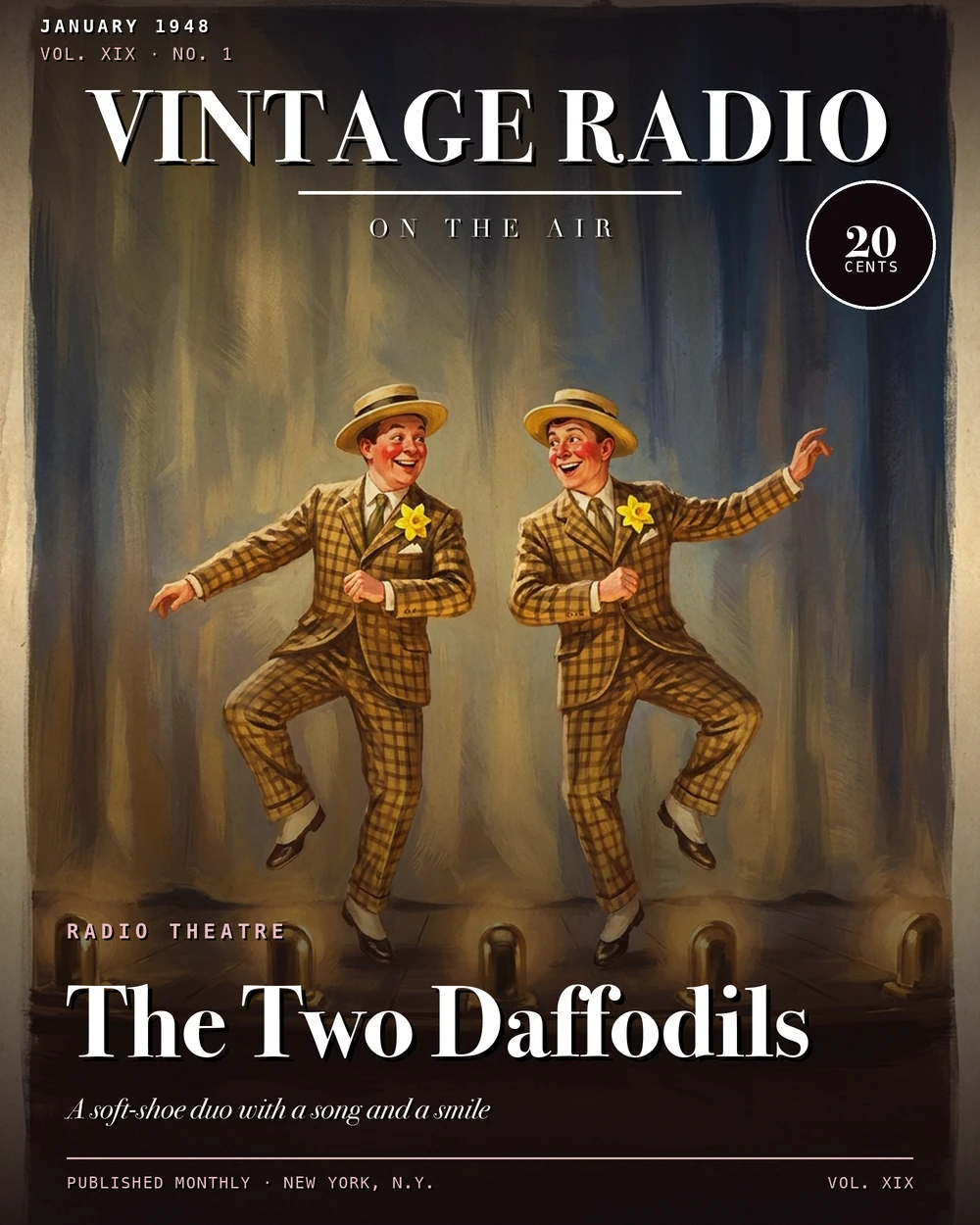
The Two Daffodils
A Vaudeville Act Moves to Radio
The Two Daffodils arrived on radio around 1930–31 as a natural extension of the vaudeville circuit — two comedians, a stack of transcription discs, and a syndication deal with the Continental Broadcasting Corporation out of Hollywood. The stars were Ken Gillum and Duke Atterbury, a pair who had already made their comic chemistry visible in a circa 1929 Vitaphone short subject, where they worked under the billing "Two College Boys." When Continental pressed the series onto heavy one-sided laminated Columbia transcription records, the act simply moved from stage and screen to the radio airwave. The matrix numbers on surviving pressings run through the 3074–3084 range, suggesting a modest production run from the start.
The title itself has a small wrinkle worth knowing. On the original disc labels, the program was identified as "Gillum and Duke Atterbury," but the on-air announcer introduced the duo as "The Two Daffodils." Which name turned up in any given radio listing apparently depended on the station carrying it. The RadioGOLDINdex database logs only a single episode, cataloged as number 2080, with disc labels pencil-dated to September 1931.
What the Episodes Actually Sounded Like
The comedy on The Two Daffodils came straight from the vaudeville tradition: quick-paced exchanges, comic characters, and novelty songs dropped in between the laughs. Gillum handled the musical end, performing novelty numbers whose titles give a feel for the era — "The Wang Wang Blues," "Boom Boom," "Dinah," "Everything Is Hotsy-Totsy Now," "Oh Boy How It Was Raining." The banter was situational and character-driven, with sketches built around the kind of everyday aggravations radio audiences recognized: taxicab rides gone wrong, airline complaints, an insurance salesman who wouldn't take a hint.
Running through the episodes were recurring comic figures beyond the Daffodils themselves. "Little Oscar" turned up as a recurring bit. "Professor Ignatz" fielded questions supposedly sent in by listeners. A poet going by the name "Ewescray" — or "Eeweyscray," depending on how you read the label — also made appearances. These recurring elements gave the show a loose repertory feel, more like a vaudeville revue with familiar players than a tightly plotted sitcom. The whole package — fast patter, character bits, and novelty songs — was the same formula vaudeville comedians had been carrying into Vitaphone shorts at the end of the silent era, transplanted now onto transcription discs.
After the Daffodils
Gillum and Atterbury didn't stop working together when The Two Daffodils wrapped. They resurfaced in at least two more syndicated comedy programs over the next few years — "Comedy Capers" (also billed as "Komedy Kapers") on the Transco syndication in 1934, and "Carefree Carnival" in 1935. Atterbury's career took him further into radio writing as the decade went on; IMDb tentatively credits him as a writer on late-1930s radio comedies, and the RadioGOLDINdex lists him as writer of a 1939 Gulf Screen Guild Theater episode directed by Busby Berkeley.
The seven episodes that survive in this catalog were transferred from the original Columbia shellac and laminated transcription pressings — the same heavy one-sided records that Continental pressed for syndication at the start of the decade. For a syndicated comedy series from 1930–31 built on a small pressing run, having seven episodes in hand is a reasonable portion of what the show ever was.